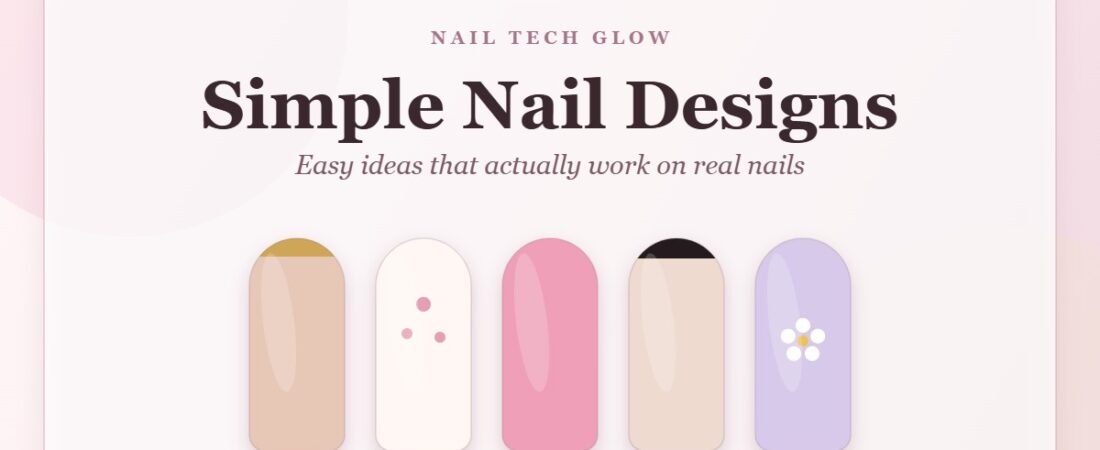
Simple nail designs are the ones you can finish in twenty minutes, with polish you already own, on nails that are probably shorter than the ones in the photo you saved. That last part is where most people get stuck. This guide is organized the way you actually search, by length, shape, color, season, holiday and product, and every design here is one you can either paint yourself or show your nail tech without apologizing for it.
What Actually Makes a Nail Design Simple
A design is simple when it passes three tests. It uses two colors or fewer, not counting your base and top coat. It takes three steps or fewer per nail. And it does not require a steady freehand line longer than about half a centimeter. If a design fails any one of those tests, it will take you an hour and you will be unhappy with at least two fingers.
This matters because a lot of nail art looks simple in a photo and is not. Tiny painted daisies with five separate petals are fiddly. Thin, perfectly even stripes running the length of the nail are one of the hardest things in nail art, because any wobble in your hand shows across the whole nail. Marble and smoke effects depend on timing the polish while it is still wet, which is a skill, not a shortcut. Ombre blended with a sponge is forgiving, but ombre blended with a brush is not.
The designs that genuinely are simple share a quality: the shape is small, or it is placed at the edge of the nail, or it is meant to look imperfect. Dots are simple because a dot has no wrong shape. Short French tips are simple because the smile line is only a centimeter wide and your natural nail edge guides you. Abstract swirls are simple because nobody knows what the correct swirl looks like. Once you learn to spot that quality, you can judge any photo before you commit an evening to it.
One more filter is worth applying before you start. Look at the nail length in the picture. A design with four separate elements on a long coffin nail has room to breathe. Squeeze those same four elements onto a short square nail and it reads as clutter. Short nails need fewer elements, not smaller ones.
What You Need to Do These at Home
You need less than the internet suggests. A base coat, a top coat, one or two color polishes and a dotting tool will carry you through about ninety per cent of the simple nail designs in this guide. The dotting tool is the single best two-dollar purchase in nail art, because it also doubles as a tool for pushing tiny shapes around and picking up rhinestones.
Beyond that, three things earn their place. Thin striping tape or French tip guides let you paint a clean edge without a steady hand. A fine detail brush, the kind with only a few bristles, handles small flowers and thin lines when you eventually want them. And nail art stickers or water decals let you skip painting altogether on the designs that are genuinely hard, which is a legitimate choice, not cheating.
What you can skip: expensive brush sets where you will only ever use one brush, stamping plates unless you already know you enjoy stamping, and the enormous rhinestone assortments. Buy a small mixed pack of clear and pearl stones and see whether you use them before you buy more. If you are working with gel, add a lamp and a no-wipe top coat to that list, because gel changes the math significantly in a way covered further down.
Simple Nail Designs for Short Nails
Short nails are the most common search behind this whole topic, and they are genuinely the easiest canvas for beginners because there is less surface area to keep neat. The trick is restraint. Pick one idea and let it sit on a clean color.
Short Square and Round Nails
On short square and round nails, anything that runs horizontally across the nail flatters the shape, and anything that runs vertically fights it. A micro French tip, meaning a very thin line of color right at the free edge, half the thickness of a classic French, makes a short nail look longer and takes about four minutes a hand. A single accent nail in a contrasting shade works better than a pattern on every finger. Two dots placed near the cuticle look deliberate and modern. A milky or sheer nude base with one thin gold line across the tip reads far more expensive than it costs.
Color blocking is the other reliable winner here. Paint the nail one color, then paint a clean diagonal or straight half in a second color. The line is short, so it is easy to keep sharp, and tape makes it foolproof.
Short Almond Nails
Short almond nails have a soft point that already carries visual interest, so they need even less decoration. A single solid color with a high-shine top coat genuinely looks finished on this shape. If you want art, put it at the base rather than the tip. A small cluster of two or three clear rhinestones near the cuticle draws the eye up the nail and makes it look longer. A simple swirl running from one side of the nail to the other suits the curve of the almond shape better than a straight line does.
What to Avoid on Short Nails
Skip full-nail patterns like plaid, checkerboard and leopard print unless you shrink them dramatically, because at normal scale they lose all definition on a small nail. Skip heavy dark colors with chunky glitter, which visually shortens the nail further. And skip anything that needs four elements to read properly, because the nail will simply look busy.
Simple Designs by Nail Shape
Almond
The almond shape is the most forgiving shape for simple nail designs because the taper does the styling for you. Sheer pinks, cool-toned nudes, soft lavender and milky white all look intentional on almond nails with no art at all. If you add anything, a thin outline of the entire nail edge in a metallic, or a single negative-space stripe left unpainted, both suit the shape. Almond nails also take the classic French beautifully, including colored, double-line and V-shaped versions.
Square
Square nails have a strong horizontal edge, and simple designs should either echo it or deliberately break it. Echoing it means straight French tips, horizontal color blocks and a line of color at the base. Breaking it means a diagonal half-and-half, or an asymmetric tip that runs higher on one side. Both look considered. Square nails are also the easiest shape for taped designs, since the straight edge gives the tape a clean anchor.
Coffin and Stiletto
Longer coffin and stiletto shapes give you space, which tempts people into complexity. The most effective simple look on these shapes is actually the opposite: a single sheer or chrome color that shows off the shape itself. If you want art, run it lengthwise, because these shapes have the length to support a vertical line or a long swirl that would overwhelm a short nail. One nail with a full glitter or chrome finish, sitting beside four plain nails, is a classic simple treatment for long nails and takes almost no skill.
Simple French Tip Nail Designs
The French manicure is the backbone of simple nail art because the design is confined to a small strip and your own nail edge acts as a guide. It is also the most flexible, because every variation reads as a different look.
The easiest modern version is the micro French, where the tip line is deliberately thin. Because it is thin, small wobbles disappear. Swapping white for a color is the fastest way to make it feel current. Black, chocolate brown, cherry red, baby blue, sage and butter yellow all work, and matching the tip to your outfit rather than to a season is a perfectly good rule.
Beyond color, three variations stay simple. The double French uses two thin lines in different colors, painted one above the other, which looks technical and is really just the same easy motion twice. The angled or slanted French runs the line diagonally rather than following the smile curve, and a straight diagonal is easier to paint than a curve. The reverse French puts the line at the cuticle instead of the tip, which suits short nails especially well because it leaves the whole nail plate visible.
If freehand makes you nervous, French tip guide stickers cost almost nothing and remove the problem entirely. Paint over the sticker, peel it while the polish is still slightly wet, and seal with top coat.
Simple Nail Designs by Color
Pink and Nude
Pink and nude are the most-searched colors in simple nail designs for a reason: they suit everyone and they hide mistakes. A sheer milky pink needs two or three thin coats rather than one thick one, which is the whole technique. For a small amount of art, a single white or gold line at the tip, or one pearl at the base of the ring finger, is enough. Baby pink with a glossy top coat is the clean girl look people search for under a dozen different names, and it needs nothing else.
Black and White
Black is the most dramatic simple color because the contrast does all the work. Black with a thin white line, white with a thin black line, black tips on a bare nail, or a single black accent nail beside four nudes all take minutes. Black also pairs well with negative space. Paint only half the nail black and leave the other half completely bare for a look that is both minimal and striking. White works the same way but reads softer, and white on short nails is particularly flattering.
Blue, Red, Green, Brown and Purple
Blue behaves differently by shade. Baby blue and powder blue read soft and springlike, navy and dark blue read formal, and a bright cobalt reads summery. Red is the one color that never needs decoration. A single coat of a true red with a glossy finish is a complete design, and adding art to it usually makes it worse. Burgundy and dark cherry are the autumn versions of the same idea.
Green has become one of the strongest simple options, with sage and olive suiting everyday wear and emerald reading as evening. Brown covers the entire fall range from milky latte to deep chocolate, and a chocolate brown French tip on a nude base is one of the most-saved simple designs of recent years. Purple splits the same way blue does, with lavender and lilac for soft looks and deep plum for dramatic ones. Whatever the color, the same rule applies: the more saturated the shade, the less art it needs.
Classy and Elegant Simple Nail Designs
Classy in nail design usually means three things: a muted or neutral color, a clean finish, and either no art or art in a metallic. A nude with a single thin gold line, a milky white with one pearl accent, a soft gray with a glossy top coat, or a sheer pink with a micro French all fall into this category.
What makes a manicure look expensive is less about the design and more about the execution. Clean cuticles, polish that does not touch the skin, even coverage without streaks, and a top coat that gives real shine will make a plain nude look better than an elaborate design applied sloppily. If you want one upgrade that changes everything, it is taking the extra minute to clean up the edges with a small brush dipped in remover. Chrome and glazed finishes belong here too. A pearl or glazed-doughnut chrome over a milky base is technically a single step with a powder or a chrome top coat, and it looks like salon work.
Cute and Trendy Simple Nail Designs
The trend cycle has moved firmly toward less. Micro art, meaning tiny motifs occupying a small corner of the nail rather than the whole plate, is the defining current style, and it is a gift for beginners because small mistakes are invisible at that scale. Milky and sheer bases with a single point of interest, soft butter yellow, chrome and cat-eye finishes, and thin lines in unexpected colors are all doing well.
Aura nails, where a soft circle of a second color glows at the center of the nail, look complicated and are achievable with a makeup sponge. Abstract squiggles are simple by definition. Two-tone nails where alternating fingers wear two colors from the same family need no art at all. And the unexpected red idea, one red accent nail against neutral fingers, is a design that costs you thirty seconds.
Simple Nail Art Motifs Anyone Can Paint
Dots and Polka Dots
Dots are the entry point to nail art and the most under-rated motif. A dotting tool, or the head of a bobby pin, gives you a perfect circle every time. Three graduated dots running up one side of the nail, a scattered handful in white over a color, or a single dot in the center are all complete designs. Dots also fix mistakes, because a smudge can often be covered with a deliberate-looking dot.
Lines, Swirls and Abstract
Short lines are easy, long lines are hard. Work with that. A single line across the tip, a short line at the base, or a curved swirl that follows the nail natural shape all read well. For lines you cannot keep steady, use striping tape as a physical guide and peel it off before the polish fully dries. Abstract designs have no correct version, so the pressure disappears completely.
Flowers
The simplest flower is five dots arranged in a circle with a sixth dot of a different color in the middle, made entirely with a dotting tool. That single technique gives you daisies, cherry blossoms and most of what people mean by simple flower nail designs. One flower on one accent nail is more effective than flowers on all ten. Scale it small on short nails.
Hearts
A heart is two dots placed side by side with a small line dragged down from between them to a point. That is the entire method. Make it tiny and place it near the cuticle or in a corner, and it reads as delicate rather than juvenile.
Glitter and Rhinestones
Glitter is the laziest legitimate design. A glitter gradient, dense at the tip and fading toward the base, is made by dabbing rather than brushing, which means no technique at all. Rhinestones need a top coat or gel to sit in while it is tacky, and the rule that keeps them looking elegant is quantity: one to three stones, placed near the cuticle, on one or two nails only.
Simple Nail Designs by Season
Spring belongs to pastels and small florals. Lilac, baby blue, soft pink, mint and butter yellow, with a single dotted flower on an accent nail. Spring is also the best season for sheer, barely-there colors.
Summer brings brightness and a reason to go simple with strong color. Neon and coral tips on a bare nail, a single white line on a tanned nude, watermelon pink with tiny black dots, or a plain bright polish with a glossy finish all work. Summer is also when toes matter, which is covered below.
Fall is the strongest season for simple designs because the colors carry the look alone. Chocolate brown, burnt orange, olive, burgundy and deep mustard need no art. If you want a motif, a single small leaf or a plain brown French tip is enough.
Winter divides into two moods: cool minimal, meaning icy blue, silver, white and chrome, and rich festive, which is covered next. A white base with a few silver dots reads as snow without being literal, and a plain deep navy with a glossy top coat is a complete winter manicure.
Simple Holiday Nail Designs
Christmas nail designs stay simple when you limit the palette to two colors. Red with white tips, green with tiny gold dots, or a plain red with one glitter accent nail cover almost every festive requirement. A white nail with three small red dots suggests holly without painting holly. Candy cane stripes are the exception to the avoid-long-lines rule, because striping tape makes them easy and the design tolerates slight unevenness.
Halloween works best with flat single shapes on a solid base. A small white ghost is two curves and two dots. A black cat is a shape, two ears and two eyes. Orange nails with one black accent nail need nothing else. Spider webs, which look complex, are just three lines crossing at a point with short connecting curves between them.
Valentine Day is dots and hearts, using the two-dot method described earlier, in red, pink or white on a nude base. A single heart on one finger is the classic restrained version. Fourth of July stays simple with color blocking rather than flags: navy on some nails, white on others, and one nail with red glitter gives you the palette without painting stars and stripes.
Easter suits pastels with speckles, which you get by flicking a nearly dry brush of a darker color across a pastel base. Thanksgiving is simply the fall palette with a gold or bronze accent. For weddings and formal events, the answer is almost always a sheer nude, a milky pink or a classic French, because the manicure should not compete with the outfit.
Simple Toe Nail Designs
Toes follow different rules because the nails are smaller, flatter and seen from further away. Anything fine or detailed disappears. Bold, simple blocks of color are what read well.
The most effective approach is to decorate only the big toe and leave the rest in a plain matching color. One flower, one small heart, a few dots, a tiny watermelon or a single stripe on the big toe is enough for the whole foot. White is the highest-impact color on toes, especially in summer, and a plain white pedicure with a glossy finish looks more expensive than most painted designs. French tips on toes work but need a slightly thicker line than you would use on fingers, because a fine line vanishes at foot distance. For simple summer toe nail designs specifically, a bright coral, a hot pink or a true red with no art at all is the most requested and the most flattering.
Simple Designs for Gel, Acrylic, Dip and Press-Ons
Regular polish is the most forgiving for art because you can wipe a mistake off with remover and try again, but it dries slowly and smudges easily. Work in thin coats and give yourself real drying time between layers.
Gel changes the process in your favor. Because the polish only sets under the lamp, you have unlimited time to arrange dots, position rhinestones and fix a wobbly line before curing. That makes gel the easiest medium for simple nail art despite the extra equipment. Rhinestones in particular should be set into a tacky, uncured layer of gel top coat and then cured, which locks them in properly. Builder gel and gel-X extensions behave the same way for art purposes.
Acrylic gives you a longer, stronger canvas, which mainly means you can use vertical designs and larger motifs. Because acrylic is usually applied professionally, this is where showing a photo matters more than doing it yourself, and simple requests such as a color, a French or one accent are the ones a tech can execute quickly and cleanly. Dip powder holds color extremely well but is harder to do detailed art on at home, so the simplest dip designs are solid colors, ombre fades between two powders and French tips. Press-ons deserve a mention because they are the genuine shortcut: applying a plain press-on and adding one dot or one thin line yourself gives you a custom design in ten minutes with none of the painting.
Four Simple Designs, Step by Step
The Micro French
Apply base coat and one or two thin coats of a sheer nude, letting each dry. Take a fine brush or the side of your dotting tool, load it lightly with your tip color, and draw a thin line along the very edge of the nail, following your natural free edge rather than inventing a curve. Work from the center outward to each corner rather than in one sweep. Seal with top coat, wrapping the top coat over the free edge.
The Dotted Accent
Paint all ten nails a solid color and let them dry fully. On one or two nails only, use a dotting tool to place three dots of a contrasting color near the cuticle, spacing them unevenly for a modern look. Let them set for two minutes before the top coat, or you will drag them.
The Two-Tone Half Moon
Paint the whole nail your lighter color and let it dry completely, because tape lifts wet polish. Lay a strip of tape straight across the nail or at a diagonal, press the edge down firmly, then paint the exposed section in your second color. Peel the tape off while the second color is still wet, at a shallow angle, and top coat once dry.
The One-Stroke Flower
On a dry base color, use a dotting tool to place five small dots in a rough circle, touching each other. Before they dry, drag the tip of a clean tool from the outer edge of each dot toward the center to give the petals shape. Add one dot of a contrasting color in the middle. Top coat when fully dry.
How to Make a Simple Manicure Last Longer
Most chipping is caused by two things: polish applied too thick, and an unsealed free edge. Two thin coats always outlast one thick one, because thick polish stays soft underneath long after the surface feels dry. Capping the free edge, meaning running your brush along the very tip of the nail after each coat including the top coat, is the single technique that adds days of wear.
Before you start, wipe the nail with rubbing alcohol or remover even if the nail is bare, because natural oils stop polish from gripping. Skip base coat only if you enjoy staining. And once the manicure is on, cuticle oil daily keeps the surrounding skin healthy, which makes even a plain color look better, though apply it after the polish has fully hardened rather than immediately.
Mistakes That Make Simple Designs Look Messy
Flooding the cuticle is the most common one. Start your brush stroke a small gap away from the cuticle rather than right against it, and let the polish self-level into that gap. Overloading the brush causes the same problem, so wipe one side of the brush on the bottle neck before each stroke.
Rushing between coats causes dragging, bubbling and dents. Adding one element too many turns a clean design into clutter, so if you are unsure whether to add something, do not. Using art colors that are too close in tone to the base makes the design invisible from arm length, which is where people actually see your nails. And painting the same design on all ten fingers is what most often makes a simple look feel heavy, because two accent nails almost always beat ten.
Frequently Asked Questions
What is the easiest nail design for a complete beginner?
Dots. A dotting tool produces a perfect shape regardless of your hand control, and three dots on an accent nail is a finished design.
How do I do simple nail designs without any tools?
A bobby pin makes dots, a toothpick makes fine marks, ordinary sticky tape makes clean lines, and a makeup sponge makes gradients. None of these needs to be bought specially.
What simple nail designs suit very short nails?
Micro French tips, single accent nails, dots near the cuticle and color blocking. Keep motifs small and limit yourself to one idea per nail.
How long do simple nail designs take?
A solid color with one accent takes around twenty minutes including drying. A French tip on all ten nails takes around thirty. Anything claiming five minutes is not counting drying time.
Can I do these designs on gel?
Yes, and gel is easier for art because nothing sets until you cure it, which gives you unlimited time to correct mistakes.
What are the most flattering simple nail colors?
Sheer pinks, cool nudes, milky white and true red suit the widest range of skin tones and never look dated.
How do I stop my nail art from smudging?
Let each layer set properly, apply thin coats, and use a quick-dry top coat applied with a floating motion rather than pressing the brush into the design.